
App Authorization Contracts
Applications declare features, operations, object requirements, and enforcement locations—engine-neutral semantics projected into policy, grants, and tests.
Identity Fabric · Decision plane
One logical ABAC decision authority for applications, data, and AI agents—fed by relationship intelligence, enforced everywhere, explainable to anyone.
One decision engine. Every relevant fact. No parallel authorization truth.
 AuthZEN 1.0 certified · PEP 01/02 and Search PEP 03
Roles live in directories. Relationships determine real scope but rarely reach the decision point. Enforcement is scattered across UI code, gateways, backends, database filters, and agent tool gateways—each interpreting access on its own terms. When fragments disagree, decisions diverge, access becomes unexplainable, and revocation becomes unsafe.
RBAC and ReBAC provide facts. One ABAC engine decides.
UI, API, backend, search, and agent enforcement points share the same logical ABAC authority—through OpenID AuthZEN interfaces to a governed PDP fabric.
Roles, grants, attributes, risk, and relationship intelligence from the graph super PIP assemble at decision time. ReBAC contributes facts—it never issues a competing permit.
Present-state explanation stays distinct from change history. Contribution-aware revocation removes one reason while preserving every other legitimate source.
Governed Authorization is not a request-in, permit-out chain. Applications declare what access means. PIPs—including the graph as a super PIP—assemble current facts. One logical ABAC authority decides through OpenID AuthZEN. PEPs enforce and may only narrow. Roles and relationships inform the decision. Policy remains authoritative.
App Authorization Contracts declare features, operations, object requirements, and enforcement locations—before any runtime request.
Bundles, personas, and governed assignments establish bounded capability. For agents: bounded delegation—never a copied human role.
Roles, grants, attributes, risk—and relationship facts from the graph super PIP. The graph contributes facts; it never issues a permit.
A PEP sends an AuthZEN request; a serving PDP instance in the governed fabric evaluates policy and returns decision context.
UI, gateway, backend, search, and agent PEPs enforce the same decision. Present-state explanation stays distinct from change history.
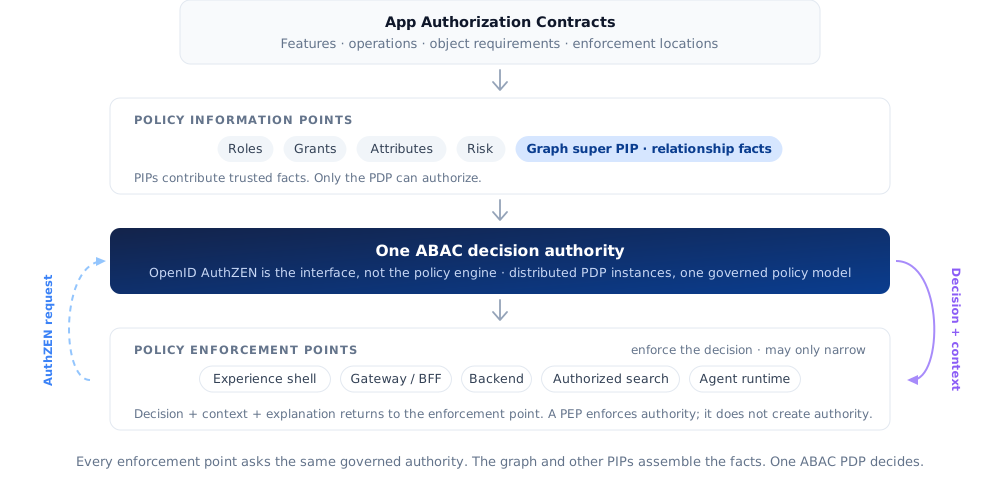
App Authorization Contracts feed Policy Information Points including the graph super PIP; one ABAC decision authority decides through OpenID AuthZEN; policy enforcement points enforce and may only narrow, with decision, context, and explanation returning to the enforcement point.
One governed policy model.
Distributed decisioning.
Because the decision plane runs on the EmpowerID Identity Fabric, serving PDP instances deploy where enforcement lives—across regions, clusters, and deployment boundaries, as SaaS or a dedicated single-tenant environment in your data center, private cloud, public cloud, or sovereign cloud. “One” means one logical authority and identical decision semantics—not one central server every request must reach.
A role may establish the capability to attempt an operation. The ABAC decision determines whether this actor may perform it on this resource under the present conditions.
Each application publishes an App Authorization Contract: business features, operations, standard bundles, and where UI, gateway, and backend must enforce. Persona Profiles assemble bundles across applications for a job function; environment bindings govern who receives them. The same PDP evaluates simple bundle assignment and advanced contextual rules. Revocation removes one contribution at a time—access disappears only when no legitimate reason remains.
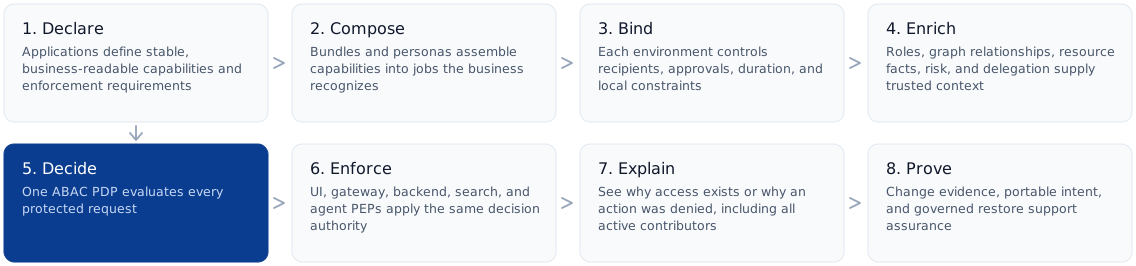
Application capability lifecycle: Declare, Compose, Bind, Enrich, Decide (one ABAC PDP), Enforce, Explain, Prove.
Applications declare capabilities. Personas compose them. One PDP decides.
Application owners declare capabilities and bundles in terms they already use—and retain visibility into who has access, through which bundle or persona, and why. When higher-risk actions require more precision, EmpowerID adds relationship, delegation, separation-of-duties, risk, device, transaction, and environmental conditions through the same decision authority. Full ABAC power is available where it matters, without turning every application onboarding into a policy-authoring project.
Application owners define the business access model. Security teams add the guardrails. One PDP decides.
Use only as much policy complexity as the decision requires.
Progressive precision · one authority throughout
Invoice Approver
access bundle · declared by the application, assigned in business terms
Conditions are added only when the decision requires them—evaluated by the same PDP as the simple assignment.
Hiding a button is presentation. Governing the action means every enforcement point—experience shell, gateway, backend, search, agent runtime—asks the same decision authority.
Applications declare features, operations, object requirements, and enforcement locations—engine-neutral semantics projected into policy, grants, and tests.
Relationship and delegation facts—ownership, membership, management scope, sharing—feed the ABAC decision without becoming a second authorization truth.
Standards-based OpenID AuthZEN between every PEP and PDP. One governed policy model distributed across regions, clusters, and deployment boundaries.
Grant Contribution Registry records every reason access exists. Remove one contribution; preserve others. Explain what remains.
Single authority for point decisions, UI capability loading, and query predicates—result counts never leak what record-level checks would deny.
Authorization before cognition. Reauthorization before action. Govern delegation creation, policy-scoped discovery, and invocation under the same logical authority.
Authorization before cognition. Reauthorization before action.
EmpowerID does not give an AI agent a copy of a human’s permissions. Every stage can narrow. No stage can widen.
Delegation
May this user delegate this tool to this agent?
Delegatable tools = agent capability ceiling ∩ owner delegation authority.
Discovery
Which tools are effective for this user, agent, and active delegation?
Policy-scoped tool surface before the agent plans—not its full registered toolbelt.
Invocation
May this agent use this tool on this resource now?
Current delegation, graph, identity, trust, risk, and data-scope facts evaluated again at action time.
Integration patterns
May this subject perform this action on this resource?
API, backend, and object actions
Which of these actions or resources are permitted?
UI capability loading and efficient multi-checks
Which records may this subject see?
Query predicates and consistent filtering—counts never leak denied records
Five questions to ask any authorization platform
The Grant Contribution Registry records every reason access exists—bundle, persona, bootstrap, or governed grant. Revocation removes one contribution while preserving every other legitimate source, and the explanation shows what remains.
Access: M. Alvarez can approve vendor payments
Illustrative product viewGrant Contribution Registry
Persona: AP Manager
Governed business-role assignment · bundle: accounts-payable approval
Direct grant: Q3 vendor migration
Time-bounded project grant · approved by finance controller
Present-state explanation
PermittedAccess is currently permitted by two independent contributions: the AP Manager persona assignment and a time-bounded direct grant for the Q3 vendor migration. Removing either one preserves the other.
Change history · distinct from present state
Know why access exists now—and preserve how it came to be. Live explanation from the authorization graph; change history from the ledger.
AuthZEN 1.0 certified
PEP 01/02 and Search PEP 03—interop-tested OpenID Authorization API interfaces.
KuppingerCole Leader
Identity Fabric and authorization leadership recognized across product, innovation, and market dimensions.
Implementation SKU: EmpowerID Authorization Service — available on the Identity Fabric services catalog.
Connected on the Fabric
SSF/CAEP updates the facts the next authorization decision sees.
Verified identity and trust context authorization consumes—including partner domains.
Secrets used after authorization permits an operation—without exposing credentials across seams.
Corroborates the external effect after authorization—what happened, not only what was allowed.
Watch an application capability, a human persona, and a delegated agent resolve to the same governed decision—with the explanation to prove it.

Online
Powered by EmpowerID AI